Card on Delivery is available as a payment method for all items on OdiKala. Now you can pay by debit/credit card, just like Cash On Delivery. We are rolling this out in Bangalore only. We accept all major Banks' Credit & Debit Cards.
1. What is Card On Delivery?
Card On Delivery means you have to pay via debit/credit card at the time of delivery.
2. Do I need to select any other option to order via Card On Delivery?
You don't need to select any other option, Just select Cash On Delivery option while choosing the Payment method & it's done.
Please remember this option is only available in Bangalore.
3. Do I need to pay any extra charges for Card On Delivery?
No, You don't need to pay any extra charges while paying with Card On Delivery Option.
4. Why is it available in Bangalore Only?
Well, we have an OdiKala branch in Bangalore. So, they will take care of your order deliveries.
5. What are the benefits of Card On Delivery?
Convenient: No need to visit an ATM or keep enough cash handy.
Safe: Transactions are 100% safe. All card data is encrypted so it cannot be misused.
Easy: All you have to do is swipe your card.
If you find this post useful then share it with your friends and family.
Contact us at support@odikala.com for any queries.
Give us your feedback in the comment section below.
Sambalpuri Sarees are the most wonderful sarees of India, these are produced in Western Odisha, mainly in Sonepur, Bargarh, Sambalpur, Boudh and Balangir Districts of Odisha. Each and Every thread of the Sambalpuri Sarees are Handwoven. All the process involved in weaving a saree is carried out manually, no machine is used in any of the steps.
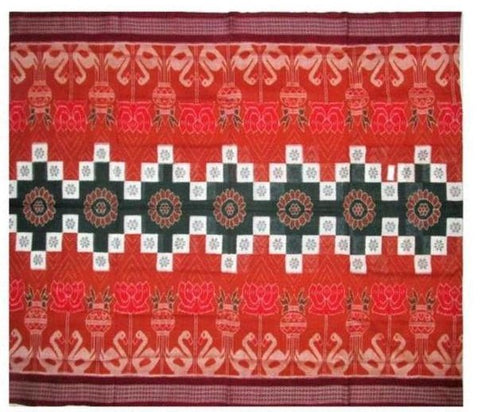
Sambalpuri sarees particularly are known for the utilization of traditional themes taking after its relationship with this shoreline state, for example, Sankha or shell, phula or flower, and chakra or wheel, swans, fish.
Swans, Lotus & Flowers weaving in Sambalpuri Saree, See this Saree
At times in some of the sarees, animal motifs also are used for enhancing the look of the pallu and borders.
The process of weaving Sambalpuri Sarees:
The process starts with dyeing the cotton/silk material. In short, the coloring process includes dipping the material repeatedly in the boiled color water. Utmost care is taken while dyeing the cotton/silk to make sure that the color is uniform throughout the material and it doesn't affect the quality of the material. Check out this video before continuing:
The most alluring part of these sarees is their association with Bandhakala-the customary craft of tie-dye, also known as Ikkat or Ikat. In this method, first, the threads are well tied and died and then they are used for weaving. This entire process usually takes more than two weeks to get completed.
Sambalpuri sarees which are made totally from textures woven unpredictably on handloom are exceptionally famous all through the nation. Again you will be astounded to realize that there are around 5 unique variations of Sambalpuri saree which are to be specific Soenpuri, Bomkai, Bapta, Barpali and Pasapali sarees.
Among all these, Bomkai, Barpali, and Bapta are highly in demand.
In Sambalpuri sarees, you get to explore new patterns including that of birds, animals, fish, conch shell, flower, wheel, landscape and much more. Draping these sarees you get the relish the authenticity of Odisha.
We also have published a blog on Handloom Weaving, Don't forget to check that as well.
Different Types of Sambalpuri Saree:
Sambalpuri sarees as said before comes in both silk and cotton texture. While the cotton sarees are for everyday use, the silk ones are implied for occasions like the example, puja, wedding, different gatherings and others. Gone are the days when the range of these sarees was restricted to the state as it were. It is presently the customary and current blend which has made every one of the variations of Sambalpuri sarees prevalent even outside India. Take a look at the forte of these saree variations:
Pasapalli Sarees:
The name Pasapali is derived from pasā or gambling games using Chess board. These saris have intricate check patterns of contrast colors resembling the chess boards which gives it such name.
Ikat Handloom Pasa Design Bapta Saree with Blouse Piece, See this product.
Bomkai sari was first originated in the village of Bomkai in Ganjam district of Odisha. During the time of Ramai Dev the then ruler of Patna, it was introduced in Sonepur.
This is another variant of the Sambalpuri saree prepared to mix both the silk and cotton fabric. Also in these sarees, gold colored threads are used which eventually enhance their elegance. Mostly they are suited for use during festive purposes.
These sarees are made in Barpali, a small town situated in the western corner of Odisha about 70 km away from Sambalpur. The specialty of these sarees is their weaving pattern of Sambalpuri ikkat fabric.
Our Sarees are 100% Genuine hand woven and not Printed. Every single design which you see on our Sarees are created with passion by the skilled weavers and craftsmen of Odisha and hence are remarkable. We believe this journey will not only help artisans of Odisha but also help customers discover and buy products which they otherwise are not able to do today. Likewise, our Sarees are made with natural colors, and traditional process and its skin-friendly. Wear ethnic and unique and be pleased.
Our fair pricing and quick service across all products aim at customer benefit at first place. Customer delight is our motto. Please give your feedback or queries by commenting below or email us: info@odikala.com Thanks for Reading, See you in our next post.